

























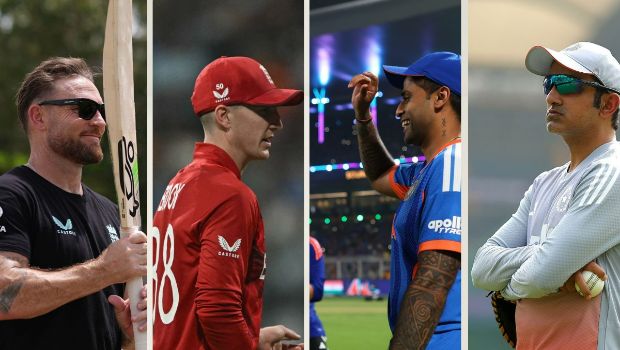
India meet England in the second semifinal of the T20 World Cup 2026 and we could not have asked for a better contest than this. These are two sides who have been equally resilient in the tournament. They may not have been at their best but have fought hard to reach here and now it is time to get better and find the best form. Both these teams are still searching for their best game in the tournament and that is what makes this contest a highly-awaited one.
If we begin with India, they look a team that has become quite match-hardened over the course of the tournament. A couple of games ago there were discussions about whether they might be thinking too much about what lay ahead rather than focusing on the present. However, in their last two matches, India have very much played in the moment. Both of those games were must-win encounters, almost like quarter-finals, and they managed to come through them successfully.
Psychologically, that experience of playing under pressure may actually prove beneficial as they head into the semi-final. While their journey to this stage may not have been ideal, the players may now feel mentally more prepared for the challenge that lies ahead.
In terms of team selection, it seems unlikely that India will make any changes. The current line-up has worked well in the last couple of matches and there is little reason to disrupt that balance. The side appears stronger with greater batting strength at the top of the order rather than including Rinku Singh further down. That configuration provides better balance to the team.
There might be a temptation to bring Kuldeep Yadav into the side given his excellent record against England. However, making such a change at this stage may be a step too far. The management will probably stick with what has been working.
One player who will attract attention is Varun Chakaravarthy. He has not quite been at his best in the big games of the tournament so far. The feeling is that he may have bowled a few too many googlies. The googly is a variation he has clearly worked hard on, even adding a little extra pace to it. However, he may need to show greater variety in his bowling, particularly by delivering more balls that move away from the right-hander. That said, his match-up with Harry Brook promises to be a fascinating one. If Surya Kumar Yadav were looking at that contest, bringing Chakaravarthy on as soon as Brook arrives at the crease, regardless of the match situation, could be a strategy worth considering.
There is also the wider context of pressure and expectation surrounding India. Playing a semi-final in Mumbai inevitably brings a certain level of scrutiny and emotional intensity. Different players will handle that pressure in different ways.
Another intriguing contest could be Arshdeep Singh bowling to Phil Salt at the top of the order. Arshdeep has bowled well to Salt in recent times and has been effective with variations in pace. Salt has occasionally found it difficult to read the lengths Arshdeep chooses to bowl, which could make this match-up particularly interesting.
India’s top order will again be the primary focus. Sanju Samson played brilliantly in the last game. Abhishek Sharma has shown signs of finding some form, even if he has not quite
reached the level he would like. Ishan Kishan has performed consistently throughout the tournament and arguably looks more composed and better suited to opening the batting.
If India can get ahead of the game through those first three batters, it will settle the middle order considerably. During the tournament there have been occasions when the top order has not fired, and the middle order has then been exposed. That situation has placed additional pressure on them to determine the right tempo at which to bat, and at times that uncertainty has held India back slightly. Therefore, India will hope their top order provides a strong platform so they can move ahead in the game and then attack England’s spinners in the middle overs.
From England’s perspective, that phase becomes a key opportunity. Breaking partnerships early will be crucial, and Jofra Archer could play a major role there.
For India, Jasprit Bumrah stands out as the best bowler on either side and the player most capable of changing the course of the match. As a result, there will naturally be a great deal of focus on how and when he is used. The most effective approach may be to keep him ready to come into the attack at moments when the game appears to be drifting away from India, or when they are in a dominant position and want to close things out. His role may therefore remain flexible, depending entirely on the situation unfolding in the match.
Another inevitable talking point will be the captaincy of Surya Kumar Yadav. In fact, leadership decisions on both sides will likely come under scrutiny. Matches of this magnitude often hinge on small moments — a decision here, a tactical call there. Consequently, the strategic choices made by both Surya Kumar Yadav and Harry Brook could prove decisive.

Overall, India appear to be well placed heading into the game. Their squad seems balanced and they appear to have most aspects covered.
For England, however, the importance of early wickets cannot be overstated. Jofra Archer becomes central to that plan. He has enjoyed an excellent tournament so far and has taken several wickets during the powerplay. England have often used up his overs early rather than holding him back for the death overs, and that strategy appears sensible. Archer will simply need to be clever with his approach and careful about the lengths he bowls.
More than a year ago, England played a T20 match against India in Mumbai where their fast bowlers — Archer and Mark Wood — bowled too short. On that occasion, India’s top order, including Abhishek Sharma and Tilak Varma batting at number three, took full advantage and dominated England. The lesson from that game is clear: England must bowl fuller, target the stumps more frequently, and vary their pace.
Selection could also be a discussion point for England. There is the possibility of bringing back Overton, although that decision may depend heavily on the nature of the pitch. If Rehan Ahmed retains his place, it must be because the team believes he has a significant role to play with the ball rather than because of his batting.
Assuming Jos Buttler is selected, which seems highly likely, he will again open the batting alongside Phil Salt.
England’s spinners could face a more difficult challenge in Mumbai than they did in Sri Lanka earlier in the tournament. Conditions there suited them because the ball tended to stick and turn, allowing players like Will Jacks, Jacob Bethell, and Rehan Ahmed to play significant roles. Those conditions also made Harry Brook’s captaincy somewhat easier because he could rotate his spinners freely.
In Mumbai, however, things may not be as straightforward. Brook will need to be more tactical about when he introduces spin, when he returns to pace, and how he uses players such as Sam Curran or potentially Overton if he is selected.
Adil Rashid will remain the central figure during the middle overs. He recently experienced both a good game and a less successful one in Mumbai, and the key for him will be finding the correct pace at which to bowl. Rashid typically prefers bowling slower through the air, but in Mumbai he may occasionally need to increase his speed slightly.
Another key question for England is whether they can target India’s sixth bowling option. In my previous article, I had suggested that West Indies should attack Hardik Pandya more aggressively but they did not do so, and they ultimately paid the price. England should look to do this. If Pandya opens the bowling, England should look to go after him and try to force India into using Shivam Dube or another sixth bowling option. West Indies were unable to expose that weakness, but England must find a way to do so if they are to win.
Ultimately, much may depend on how effective players like Will Jacks can be in Indian conditions. Having played for Mumbai Indians, Jacks is familiar with the environment. Liam Dawson has also performed well, and there could even be a case for opening the bowling with him despite the presence of multiple left-handers near the top of the order. His spin could be valuable early in the innings.
As always, the final decisions will depend heavily on the pitch and the exact conditions on the day.
England’s biggest strength in this series has been their resilience. They haven’t played their best cricket throughout, but they’ve consistently found ways to win. Under Harry Brook’s captaincy, they have won 16 of their last 18 matches, which has created a strong winning mindset within the team.
Even by their own admission, their performances haven’t always been at their highest level. However, their ability to grind out victories in tight situations has become a defining quality. That knack for winning close games could be one of their greatest strengths heading into this match, alongside the presence of several high-quality players in the side.