


























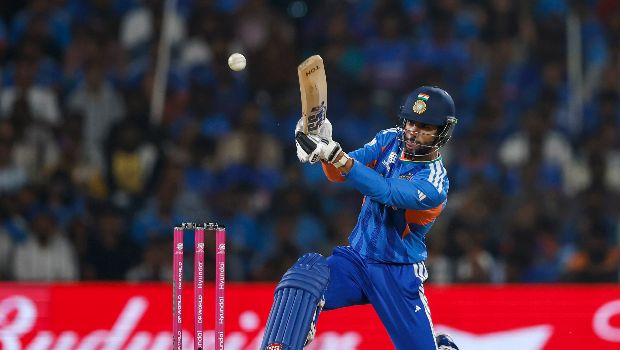
Have India, by force rather than design, unlocked a more dangerous version of Tilak Varma?
In a must-win T20 World Cup clash in Chennai against Zimbabwe, India made a call that raised eyebrows before it delivered results. Tilak, who had batted at No.3 throughout the tournament, was pushed down to No.6 amid a broader rejig prompted by poor form and evident discomfort against spin in the top order. What followed was emphatic: an unbeaten 44 off just 16 balls, three fours, four sixes, and a strike rate of 275 — powering India to their highest-ever total at a T20 World Cup.
On the surface, it was a late-innings cameo. In context, it may have been far more significant.
Tilak’s tournament until then had been underwhelming. Back from surgery after over a month and slotted right back into the pivotal one-down role after early wickets, he had struggled to impose himself, particularly against spin. Timing deserted him. His footwork appeared hesitant. The fluency that marked his rise in 2024 and 2025 was missing. To be fair, he was returning from an injury layoff following surgery, and rhythm is often the last thing to return. Yet at No.3 in T20 cricket — especially in a global tournament — there is little room for extended recalibration.
India’s reshuffle in Chennai was born of necessity. Multiple batters were short of runs, and opposition teams had begun targeting India’s vulnerabilities against spin in the middle overs. By dropping Tilak to No.6 — still ahead of the regular occupant of that slot — the management effectively shielded him from early exposure to spin while preserving his presence in the finishing phase.
The impact was immediate. With a strong platform laid by the top order and Zimbabwe’s pacers operating at the death, Tilak was able to play with clarity. Freed from consolidation duties, he attacked from ball one. His swing arc was decisive, his base stable, and most notably, his intent unambiguous. This was not survival batting; this was assertion.
It raises an uncomfortable but necessary question: had India miscast him at No.3 in this tournament?
Tilak has the technique to bat in the top order. His range against pace is extensive, and at his best, he is more than capable against spin. But form and matchups matter in tournament cricket. In conditions where spin has dominated middle overs, asking a batter low on confidence to rebuild innings repeatedly may have compounded the issue.

At No.6, the variables change. The tempo is clearer. The role is defined. Pace is more likely at the back end, and fields are spread. For a stroke-maker regaining rhythm, it can be liberating.
This tactical nuance becomes even more relevant with a virtual quarter-final looming against a spin-heavy West Indies attack. Their three frontline spinners have controlled phases effectively, while their pacers have, at times, proved more hittable at the death. Structurally, deploying Tilak lower again could maximise matchups while minimising risk.
There is also a broader team philosophy at play. India have often leaned on “flexibility” in white-ball cricket, adjusting roles based on opposition and conditions. Yet flexibility without clarity can create insecurity. For Tilak, a defined brief at No.6 — at least until he fully rediscovers his authority against spin — might provide stability rather than demotion.
When Tilak spoke to this writer back in December about wanting to express himself and impose on bowling attacks in his first World Cup, this was the version he likely envisioned. The Zimbabwe innings was not merely about those 44 runs; it was about body language, decisiveness, and timing rediscovered.
Whether this becomes a long-term shift or a situational adjustment will depend on Sunday’s outcome and the management’s appetite for recalibration. But one thing is clear: in seeking to solve immediate problems, India may have stumbled upon a configuration that unlocks Tilak’s most destructive self.
And in knockout cricket, that could make all the difference.