


























The ODI series between India and South Africa has left cricket fans with one major question overshadowing strategy, selection, and form – what is a safe total in modern-day ODI cricket?
KL Rahul lost the toss in Ranchi and Raipur to make it 20 consecutive times that an Indian captain had loss the toss, and when he finally did win one ahead of the decider, his decision was straightforward and expected. Each captain – and there were three for three matches – chose to field, keeping in mind the dew factor that made defending an extremely tough challenge.
In Ranchi, India posted 349 and still found themselves pushed to the brink before closing out a narrow victory by 17 runs. In Raipur, centuries from Ruturaj Gaikwad and Virat Kohli – the latter registering his 53rd ODI hundred – powered India to 358. Yet South Africa completed the chase with four wickets in hand, exposing once again how the balance of power in ODI cricket continues to tilt towards chasing sides.
The dew factor, particularly during the onset of winter in India, has become central to planning. Spinners have struggled for grip, defensive lines have been hard to control, and seamers – including the returning Prasidh Krishna and the usually disciplined Arshdeep Singh – found the wet ball difficult to manage under lights.
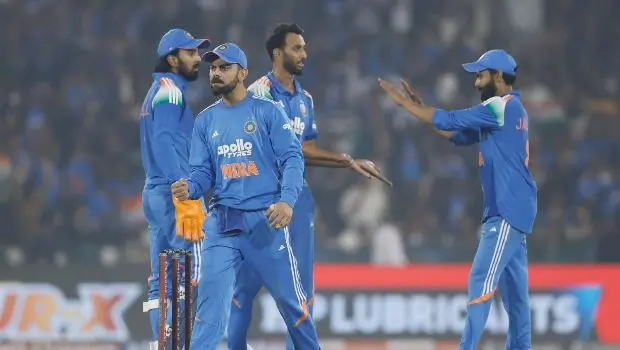
In Visakhapatnam, it was South Africa’s turn to look bereft of ideas as India’s batting went after the target with little worry. And earlier in the day, the sight of India’s bowlers smiling and laughing told a story: a drier cricket ball made their job much easier. And it was no surprise that Kuldeep Yadav and Prasidh picked up four wickets each in that match.
If the toss and dew factor are going to decide cricket matches in these parts – and let’s not forget that the T20 World Cup will start in early February – then the ICC and all stakeholders will at some stage need to address the issue. As recent results suggest, winning the toss may prove as decisive as any tactical nuance. In an era where totals near 360 no longer guarantee control, the question remains: how much is enough, and for how long?
Beyond the toss and dew, in a T20I-heavy year a three-match ODI series was of little significance, but two aging superstars attracted plenty of attention. Kohli, 37, and Rohit, 38, only play one format now and there has been a fair degree of surmising about their futures with an eye on the 2027 World Cup.
Rohit was Player of the Series during the series loss in Australia last month, after scoring a fifty and a hundred, and against South Africa it was Kohli’s turn to pick up the recognition for scores of 135, 102 and 65*. Rohit managed two fifties in three games to show that he has enough gas in the tank, and Kohli bossed the South African bowlers like he has not done for a while.

His running between the wickets remains second to none, his awareness of match situations is peerless, but it was his aggressive intent that really stood out. Rarely in a career spanning 308 ODIs has Kohli took on the bowlers so early and with the intent to hit the ball in the air. In fact, his risk-free approach is what helped him amass over 14,500 runs.
Against South Africa, he skipped down the track to the pacers inside the Powerplay and didn’t hesitate to whip the spinners over the infield well before he had crossed the 50-run mark. Kohli’s strike-rate for the series – in which he made 302 runs – was 117, which for a cricketer at 37 is very good. He looked like a man on a mission, and that mission appears to be the World Cup in two years.
Yashasvi Jaiswal got three matches in Gill’s absence, failed in the first two and in the decider, he raised a maiden ODI century. He will probably remain India’s third opener for the future, but has a fair bit to do in terms of working out his weakness against left-arm pace and also what tempo the format demands.
With Shreyas Iyer out injured, India tried Ruturaj Gaikwad at No 4 and in the second ODI the recalled batsman – an opener, regularly – scored a very fine century off 77 deliveries. Rahul scored fifties in the two innings he got, further underlying his utility as a middle-order player, but the lower order appeared muddled.
Washington Sundar’s inability to hit a long ball is somewhat problematic. Ravindra Jadeja seems a spent force at 37, and his two innings in this series showed the good and bad of what he offers. India need Iyer and Hardik Pandya back, because both can tee off at the death. Where Rishabh Pant stands is also not clear, because he has not been given an chance in ODIs since 2024 despite being in the squad.
As for the bowling, it was good to see Arshdeep get regular playing time. India’s leading wicket-taker in T20Is needs to play more 50-over cricket, because at 26 he is too good a talent to keep for just one format. Harshit Rana ends 2025 as India’s leading wicket-taker with 20 and an economy rate of 6.01 and has done enough to remain in India’s World Cup plans. Prasidh, however, looks the likeliest to get the chop when Bumrah returns. He has been erratic and expensive, even though he did terrifically to come back and deal South Africa the killer blow in his second spell in Visakhapatnam by dismissing Matthew Breetze and Aiden Markram in one over and then bowling the centurion Quinton de Kock in his next.
Kuldeep struggled with a damp ball but was back in his groove in the decider, taking four wickets to end the year with 19 wickets.