


























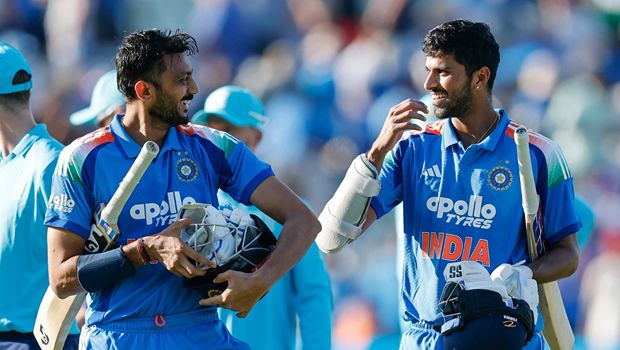
One of the biggest talking points from India’s latest ODI was not a spectacular innings or a match-winning spell, but a tactical batting-order decision. When the opportunity arose, Washington Sundar was sent in at No. 5 ahead of KL Rahul, a move that immediately raised eyebrows.
At first glance, it appears to be a surprising call. Rahul is not only one of India’s most accomplished ODI batters, but his record at No. 5 is among the strongest in the current squad. Washington, meanwhile, has rarely batted in that position and has not exactly been in the best of form.
The numbers paint a clear picture.
Washington had batted at No. 5 in an ODI only once before this match. Rahul, on the other hand, has occupied that position on 35 occasions, averaging an outstanding 63 with a strike-rate of 100. He has scored three centuries and 10 half-centuries from No. 5, making it comfortably his most productive batting position.
Since the start of 2025, Rahul batted at No. 5 five times and at No. 6 on 13 occasions. While he has still contributed useful runs lower down the order, his overall record at No. 6 is notably less impressive, averaging 37 from 14 innings with a strike-rate of 98 and just one half-century.
Statistically, therefore, there is little debate. Rahul at No. 5 has been significantly more successful than Rahul at No. 6, and there is no meaningful comparison between his record and Washington Sundar’s in that role.
So why would India persist with such a move?
There are two possible explanations.
The first is a familiar tactical ploy. India’s top order is heavily right-handed, and the management may be looking to disrupt that sequence by inserting a left-handed batter in the middle order. It is a strategy that worked well with Axar Patel during last year’s Champions Trophy, when his promotion helped improve the batting balance and created more difficult match-ups for opposition bowlers.

If that is the thinking, Washington’s promotion could simply be an attempt to achieve a similar tactical effect.
The second explanation may have more to do with the recent ODI playing-condition changes.
Under the revised rules, only one ball continues to be used after the 34-over mark. As a result, the ball is older for a longer period, making stroke-making towards the end of an innings more challenging than it has been in recent years. In that scenario, there is a strong argument for keeping a technically sound, reliable batter like Rahul at No. 6 to guide the innings through the closing overs rather than relying solely on power-hitting.
Viewed through that lens, Rahul’s demotion is perhaps not a demotion at all, but a role specifically designed for the demands of modern ODI cricket.
Of course, the equation could change once Hardik Pandya returns to the side. His presence would restore India’s proven finishing ability and allow the batting order to revert to a more conventional structure, especially with next year’s ODI World Cup on the horizon.
For now, though, there is genuine merit in the idea of Rahul batting at No. 6.
The bigger question is whether Washington is the right choice to bat ahead of him.