
























There’s a familiar dilemma unfolding at Manchester United: reward short-term results or commit to a bigger long-term vision. Right now, Michael Carrick has done enough to make the decision uncomfortable. Results have improved, performances look more stable, and the team is once again flirting with a return to the Champions League.
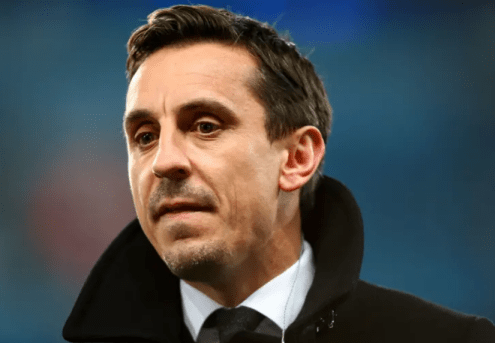
But not everyone is convinced that momentum should automatically lead to permanence. Gary Neville has stepped into the conversation with a clear message—this is not the moment for caution. In his view, this is the moment to be ambitious.
Neville’s argument isn’t based solely on Carrick. It’s rooted in what’s happening around the league.
From his perspective, the traditional power structure in English football is not as solid as it once was. Clubs that usually dominate are showing signs of inconsistency. Arsenal FC remain competitive but not untouchable. Liverpool FC have shown instability. Chelsea FC and Tottenham Hotspur continue to struggle with identity and results.
Therefore, Neville believes this creates a rare opening—an environment where a well-structured United side could realistically challenge for the title within the next two seasons. Not because they are currently the best team, but because the gap to the top is no longer as wide or as consistent.
His concern is simple: if that opportunity exists, the club cannot afford to approach it conservatively.
Carrick’s current run—nine wins in thirteen matches—has brought optimism back to Old Trafford. But Neville questions whether a strong interim period is enough evidence to trust him with a project that requires navigating domestic competition, European fixtures, and long-term squad development.
In other words, the job is about more than stabilizing a season. It’s about capitalizing on a moment.

There’s no denying Carrick’s impact. He has simplified the team’s structure, improved consistency, and reconnected players with a clearer identity on the pitch. Internally, he is trusted. Externally, he is respected.
But Neville’s hesitation revolves around scale.
Managing a club like Manchester United over a full season—across the Premier League, European competitions, and domestic cups—is fundamentally different from guiding a team through a short recovery period. The physical demands, tactical adjustments, and squad rotation required at that level introduce a new layer of complexity.
Paul Scholes echoed a similar concern, pointing out that Carrick has not yet had to deal with that intensity. Competing every three or four days changes decision-making, squad depth requirements, and even training cycles.
Neville’s position is not anti-Carrick. It’s strategic.
He outlines two possible approaches. One is to allow Carrick to continue building culture and structure, laying a foundation that someone else could later inherit. The other is more immediate—appoint a proven, high-level manager now and attempt to accelerate the club’s return to the top.